Stepping-up: The Census Bureau Sets an Example of How to Be a Good Data Steward in the 21st Century

Talkat Data Privacy: From Foundations to Applications (Simons Institute workshop, 2019) · 2019-03-04..03-08·
summary
Publicly disclosed experiments reconstruct all 308,745,538 2010 person records from five variables and match block/sex/age/race/ethnicity exactly for 46% (71% within ±1 year), yielding a 45% putative and 38% confirmed reidentification rate (≈52 million, 17% of the population). The Census adopts differential privacy, treats noise infusion as necessary, exposes algorithms and code, and confronts a workload of ~100 billion queries. Policy choices allocate a finite privacy-loss budget (epsilons like .25–10) across products to trade off block-level accuracy versus aggregate usability.
AI-written summary · about
chapters (8)
- 0:00The changing privacy landscape
- 4:51Census and privacy statutes
- 6:57Core privacy principles
- 9:33Database reconstruction study
- 14:51Implementing formal privacy
- 28:45Accuracy and privacy trade-offs
- 37:57Policy and management
- 49:29Q&A and concluding remarks
related talks
 20mShare data without revealing personal information
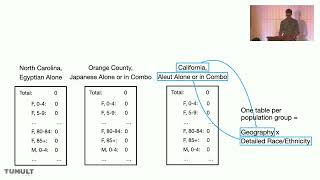 15mDifferentially Private Algorithms for 2020 Decennial Census Detailed DHC Race & Ethnicity
 33mPractical Data Privacy
 01h 00mPractical Difficulties in the Application of Differential Privacy for the Release of Large-Scale...
 50mData Privacy Concerns - A Risk Based Approach to De-Identification
 01h 43mPerspective
 40mApplied Privacy Engineering Study
 43mAnalyzing Administrative Data with Privacy Protection in Place