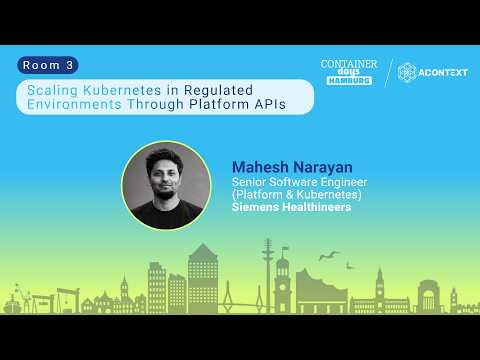
Scaling Kubernetes in Regulated Environments Through Platform APIs
summary
Siemens scales Kubernetes across 30 platform teams and decades‑old medical devices by replacing raw cluster primitives with intent‑based platform APIs that enforce RBAC, network policies, encrypted storage (avoiding unencrypted CNPG Postgres), and audit labels so teams aren’t cluster experts. They run a Windows‑native K2S distro, use Flux and migrated ingress to Gateway API, and face 15+ year support constraints. Platform APIs cut fragmentation and upgrade pain but create bottlenecks and risky abstractions unless they expose logs and CPU/memory signals and evolve GPU capability surfaces.
AI-written summary · about
chapters (6)
- 0:00Introduction and background
- 3:24Kubernetes adoption challenges
- 7:39Security and compliance issues
- 11:54Platform APIs as solution
- 16:10Governance and abstraction balance
- 20:43Key learnings and conclusion
related talks
 24mSelf-Service Multi-Cloud K8s Platform at a Regulated Financial Enterprise
 31mThe 20 Year Platform – bringing together Kubernetes, 12-Factor and Functions
 40mThe Elephant in the Kubernetes Room: Team Interactions
 43mPlatform Engineering Redefined: Evolving Kubernetes Beyond Container Orchestration
 26mKubernetes Is A Platform Platform
 41mTales of the mythical Cloud-Native Platform
 21mPlatform Perseverance: Taming 1,000 Kubernetes Clusters
 30mEdge Kubernetes and Healthcare: A Next-Gen Architecture that Scales Across Thousands of Locations