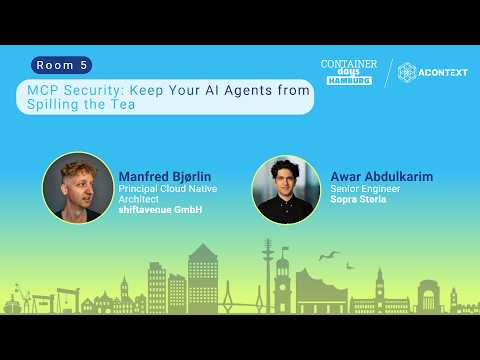
MCP Security: Keep Your AI Agents from Spilling the Tea
summary
MCP security discussion shows a concrete self‑hosted setup: KAgents on AKS running version 0.9, pulling models (including Olama) and exposing ~12 MCP tools per agent, with Kubernetes RBAC mapped to agent pods and an elicitation approval workflow that pauses actions until human approval. It flags practical limits of RFC8693 token exchange (on‑behalf tokens grant full user rights), confirmation fatigue, reverse prompt injection, dynamic discovery expanding attack surface, and demonstrates that fine‑grained tool scoping plus runtime approval reduces but does not eliminate privilege escalation risks.
AI-written summary · about
chapters (11)
- 0:00Introduction and presenters
- 1:10MCP security overview
- 3:16AI firewall and guardrails
- 5:44Token reuse and elicitation
- 8:16Access control challenges
- 11:05Pitfalls of MCP servers
- 14:01Live demo introduction
- 15:05K Agents tool overview
- 21:48Elicitation and policy enforcement
- 23:32Benefits of K Agents
- 24:34Q&A session
related talks
 44mMCP Security: Keep Your AI Agents from Spilling the Tea
 15mWhy Security Matters: The Risks of Agentic AI and How to Mitigate Them
 26mWho Let the Agent In? Securing MCP Servers in Production
 50mMCP at Scale: Governing AI Agent APIs When Autonomous Systems Are Your Consume…
 34mBalancing Security and Innovation in Multi-Agent Systems: An Open Source Approach
 26mGovernance and Security of APIs and MCPs
 36mPutting AI Agents to Work: A New Era of Open Source Connectivity with MCP
 23mIdentity Best Practices to Secure & Scale Agentic AI / MCP Deployments