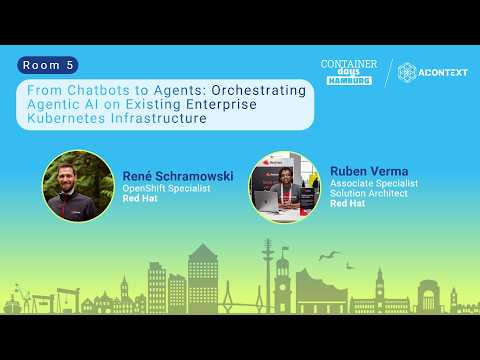
From Chatbots to Agents: Orchestrating Agentic AI on Existing Enterprise Kubernetes Infrastructure.
summary
Shows a working loan-chatbot stack deployed on existing Kubernetes using OpenShift AI and operators to manage model serving, Jupyter workbenches and GPUs; tracing via the MLflow operator and Grafana reveals full call graphs so the model’s tool calls (product-info, RAG lookups) are visible rather than just HTTP 200s. Demonstrates multi-agent systems as distributed apps, supports self‑hosted models (8B-class examples) and Jupyter-driven evaluation, and argues observability and governance are the real operators’ work.
AI-written summary · about
chapters (14)
- 0:00Introduction and speaker intro
- 1:13From GenAI to agentic AI
- 4:23Enterprise adoption challenges
- 5:45What is an AI agent
- 6:48Hosting models on Kubernetes
- 8:13AgentOps with Kubernetes
- 9:36Demo of AI app on Kubernetes
- 12:28AgentOps features and observability
- 15:23Demo of agent tracing and metrics
- 18:52Evaluation and security in AI platforms
- 20:37Future of self-hosted AI agents
- 21:42Demo of model evaluation
- 23:08Key takeaways and intentional choices
- 24:33Q&A session
related talks
 41mGetting real DevOps ROI with your Generative AI
 31mBuilding and Orchestrating Real Production-ready Agentic AI Systems
 23mAgents in Kubernetes 101: A Crash Course on Cloud Native AI Agents
 27mAI-Powered ETL Pipeline Orchestration: Multi-Agent Systems in the Era of Generative AI
 35mCase Study: AI-as-a-Service on Kubernetes at Scale and In Production
 40mAgents in Action: Advancing Open Source AI Missions
 34mScaling and Orchestrating “Good Bot” With Kubernetes
 13mExploring AI-Powered Chatbots and Their Transformative Role