The Rank of Sparse Random Matrices
summary
Three random-matrix models (a sparse k-nonzeros per row model, a degree-prescribed simple/flexible models, and a general-field version) have typical rank(A)/n = 1 − sup_{α∈[0,1]} Φ(α) where Φ is built from the PGFs of row/column degrees; the earlier upper bound becomes exact and the result is essentially field-insensitive. Proof uses the peeling two-core analysis to reduce rank to core size, a cavity/coupling estimate of nullity via log |solution space|, and a pinning strategy to kill short relations; maxima at α=0 gives full row rank.
AI-written summary · about
chapters (15)
- 0:00Introduction
- 0:37Overview
- 0:55Simple Model
- 1:56Flexible Model
- 5:12Rank of Simple Model
- 5:43Rank of Flexible Model
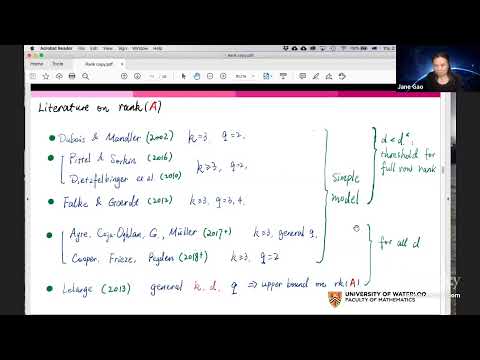
- 8:35Literature Review
- 10:58What is the maxima for
- 13:25Rank of a
- 16:49How the proof works
- 18:24Properties of the noun space
- 21:00The trick
- 22:21The formula
- 23:01The key features
- 33:00Proof
related talks
 32mRandomized Numerical Linear Algebra: Overview
 01h 04mUser-Friendly Tools for Random Matrices I
 23mHow Large is the Norm of a Random Matrix?
 01h 27mPast, Present and Future of Randomized Numerical Linear Algebra I
 43mGeometric Complexity Theory and Tensor Rank
 23mLow-Rank Matrix Recovery Through Rank-One Projections
 59mElementary Results on Maximal, Generic and Typical Ranks
 48mRandomized Numerical Linear Algebra