Correlation Decay for Hard Spheres via Markov Chains

summary
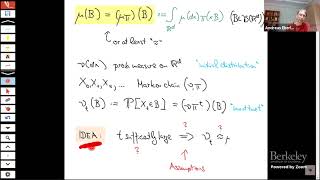
Defines and analyzes a rejection-free single-center dynamics that picks a random location, adds a disk with probability λ/(1+λ) if it fits, or removes nearby centers with probability 1/(1+λ), and proves this chain is rapidly mixing for λ < 2^{-d+1}. Proof uses path coupling on an extended state space allowing overlaps up to two and a metric based on occupied neighborhood volume; from rapid mixing it deduces strong spatial mixing and thus lower bounds λ_c ≥ 2^{-d+1} and a corresponding density bound (~(2/3)·2^{-d}).
AI-written summary · about
chapters (21)
- 0:00Start
- 0:33Correlation Decay for Hard Spheres via Markov Chains
- 0:50The Hard Sphere Model
- 1:19Hard Sphere Model
- 3:34The Hard Sphere Model
- 4:22Decay of Correlations
- 5:29Conjectured Phase Transition for the Hard Sphere Model
- 6:13Phase Transition
- 8:41What a Markov Chain Is
- 11:31Markov Chains and Phase Transitions
- 11:46Optimal Temporal Mixing
- 12:09Optimal Temporal Mixing Implies Strong Spatial Mixing for the Hard Sphere Model and Single Center Dynamics
- 13:14Strong Spatial Mixing
- 13:49Boundary Conditions
- 14:50Known Lower Bounds
- 16:37Canonical Sphere Model
- 18:49Extending the State Space
- 20:49Path Coupling Approach
- 21:11Block Volume
- 24:18The Markov Chain
- 31:25Hexatic Phase
related talks
 01h 03mSampling Crash Course
 01h 03mSampling Crash Course (continued)
 01h 14mRecent Progress in High-Dimensional Learning
 01h 04mHigher-dimensional Expansion of Random Geometric Complexes
 24mRandom Max-CSPs Inherit Algorithmic Hardness from Spin Glasses
 01h 14mSampling Using Diffusion Processes, from Langevin to Schrödinger
 01h 04mWalking Graph States: General Ansatz for Non-equilibrium Density Operators of Quantum Chains
 29mApproximating Spherical Gaussian Mixtures