Free Energy Wells and Overlap Gap Property in Sparse PCA
summary
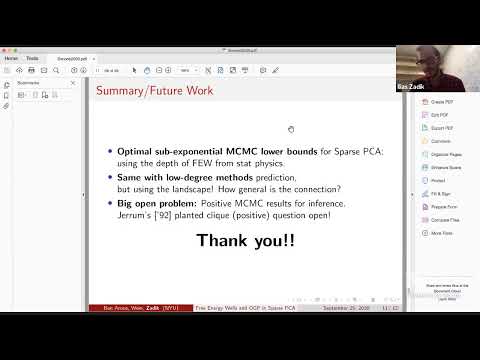
Analyzes sparse Principal Component Analysis (sparse PCA) in the sparse Rademacher spike model, examining how free energy wells and the Overlap Gap Property (OGP) relate to algorithmic hardness. Uses statistical physics concepts (free energy wells) and the OGP framework to identify regimes where polynomial-time algorithms fail versus succeed for recovering the sparse spike.
AI-written summary · about
chapters (9)
- 0:00Intro
- 2:45The Sparse PCA Model - Literature
- 5:17The Sparse PCA Model - Sub-exponential time method
- 8:05Stationary distributions: Gibbs measures
- 11:22Free Energy Wells (FEW) from Statistical Physics
- 14:03A deep FEW slows MCMC methods
- 21:24Main Result on FEW
- 23:24Proof Sketch
- 26:12Summary/Future Work
related talks
 39mMemory Limited, Streaming PCA
 36mThe Overlap Gap Property For Inference: Power And Limitations
 28mRandomized Constrained Matrix Decompositions
 01h 06mTutorial: Methods from Statistical Physics II
 29mAre Generative Models The New Sparsity?
 24mRandom Max-CSPs Inherit Algorithmic Hardness from Spin Glasses
 45mHigh Dimensional Robust Sparse Regression
 49mRobust PCA via Non-convex Methods: Provable Bounds