Overview of Generative Adversarial Networks (GANs)

summary
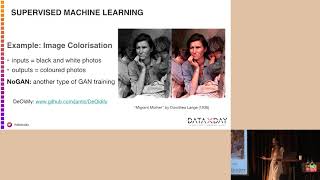
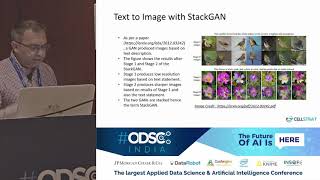
Covers what GANs actually do and how they work: two networks trained adversarially, generator and discriminator, with the usual training instabilities and the practical tweak to the original loss. Demonstrates architectures and results: ProgressiveGAN and StyleGAN producing photoreal faces, BigGAN producing 512×512 ImageNet classes, and cycleGAN for domain transfer. Shows adversarial examples that flip labels with tiny perturbations (~0.007) and practical uses like synthetic data for class imbalance and semantic map synthesis from Nvidia.
AI-written summary · about
chapters (29)
- 0:00Introduction
- 1:42Jakubs background
- 2:47Outline
- 3:22supervised machine learning
- 4:45Generative modeling
- 6:34Difficult to quantify
- 8:11GANs
- 10:00Recap
- 10:36Analogy
- 12:02Loss Functions
- 15:11Why is this an interesting problem
- 16:25Synthetic human faces
- 17:23Pretty faces
- 17:34Cycle
- 21:25Discriminators
- 23:04ImageNet
- 24:58ArtBreeder
- 25:47Adversarial Examples
- 26:10Adversarial Noise
- 30:20Modern Machine Learning
- 31:14Key Takeaways
- 32:14Examples
- 35:19Input
- 36:03Synthetic Data
- 37:11Exotic Applications
- 37:33Other Applications
- 38:00Academia
- 38:51Everybody Dance
- 39:22References
related talks
 43mHitchhiker’s Guide to Generative Adversarial Networks (GANs)
 47mUnmasking Generative Adversarial Networks
 27mAdversarial Intelligence: Using GANs in Cybersecurity
 24mThe Bad Guys in AI: Attacking Machine Learning Systems
 37mHarnessing the power of Generative Adversarial Networks (GANS) for supervised learning
 28mApplications of Generative Modeling
 44mGenerative Adversarial Networks (GANs) and Stable Diffusion
 13mNavigating Generative AI and Its Risks