Informational Substitutes and Complements for Prediction
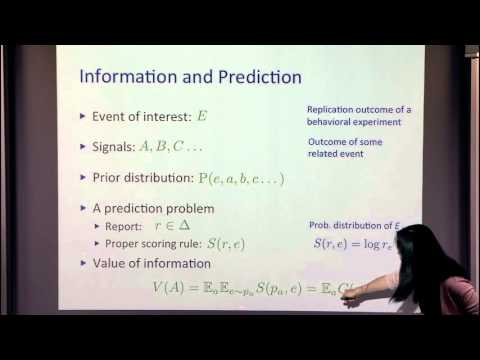
summary
Formal definition uses Blackwell ordering to call signals substitutes when additional information has decreasing marginal value and complements when it has increasing marginal value, proven equivalent to checking prediction problems with proper scoring rules. Main game-theory claims: strict substitutes imply myopic (early-reveal) equilibria while strict complements imply delay equilibria. Empirical note: a prediction market run for 41 psychology replications achieves about 71% accuracy while the underlying replication rate is about 39%.
AI-written summary · about
chapters (15)
- 0:00Intro
- 0:54Roadmap
- 3:18Information (Bayesian View)
- 3:51Information and Decision
- 6:04Information and Prediction
- 16:19Information Aggregation in Prediction Markets
- 23:33Information Aggregation in Prediction Markets
- 24:50Substitutes and Complements
- 26:03Prior Definition Börgers et al. '13
- 30:17Place a structure on signals
- 31:29Substitutes of signals
- 36:00Revelation Principle
- 39:11Equilibria of Prediction Markets
- 41:05Signal Classes
- 42:57Ongoing and Future Directions
related talks
 23mFalse Consensus, Information Theory, and Prediction Markets
 04mOn gradient-based methods for finding game-theoretic equilibria
 46m(Improving) Muddled Information
 26mStop Explaining Black Box Models, Use Interpretable Models Instead
 38mTo explain or to predict?
 29mEfficient Minimax Optimal Strategies for Universal Prediction
 01h 18mPrediction, Generalization, Complexity: Revisiting the Classical View from Statistics Part 1
 01h 02mPrediction, Generalization, Complexity: Revisiting the Classical View from Statistics Part 2