An Evolutionary Model of Economic Behavior, Bounded Rationality, and Intelligence

summary
A simple evolutionary model has agents that inherit a fixed mixing probability F for a binary choice and reproduce with random offspring XA or XB; with shared vs idiosyncratic risk the math (population arithmetic, LLN, simulations) yields either exact probability matching at 75% (shared draws: 75% sunshine → F*=0.75) or deterministic play (IID draws), explains why optimizing agents (F=1) get wiped out by the first rain, shows 99.9% inheritance with 0.1% mutation preserves all Fs, and defines intelligence as positive action–outcome covariance.
AI-written summary · about
chapters (8)
- 0:00Intro
- 0:50Motivation
- 8:06Binary Choice Model
- 18:27Population Arithmetic
- 22:10Probability Matching Explained
- 34:15Systematic vs. Idiosyncratic Risk
- 38:12Bounded Rationality and Intelligence
- 41:17Other Extensions
related talks
 42mProbably
 46m(Improving) Muddled Information
 01h 18mPrediction, Generalization, Complexity: Revisiting the Classical View from Statistics Part 1
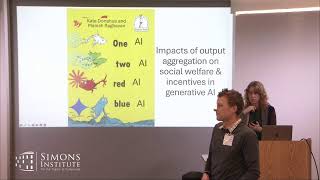 41mOne AI, two AI, red AI, blue AI: Impacts of Aggregation on Model Diversity and Consumer Utility
 49mMathematical Problems in the Evolution of Senescence
 51mExpert Advice in Complex Environments
 29mPure Exploration Problems
 23mFalse Consensus, Information Theory, and Prediction Markets