Collie: Finding Performance Anomalies in RDMA Subsystems

Talkat 19th USENIX Symposium on Networked Systems Design and Implementation (NSDI '22) · 2022-04-04..04-06·
summary
Collie systematically searches RDMA workload space using simulated annealing guided by hardware performance and diagnostic counters to drive tests toward extremes. It models verbs and memory/transport/request dimensions, runs experiments on just two hosts across eight RDMA subsystems (six NIC generations, two vendors), and discovers 15 new anomalies (7 already fixed), including PFC pause‑frame storms and host‑migration throughput collapses, plus a minimal feature set technique to map anomalous workload regions.
AI-written summary · about
chapters (15)
- 0:00Intro
- 0:28RDMA are getting rapidly adopted
- 0:42There exist unexpected performance anomalies
- 3:38Existing integration tests
- 5:19Strawman solutions are not enough
- 6:05Question: How to define performance anomaly
- 6:49Challenge #1: Comprehensive Search Space
- 7:02Challenge #2: Efficient Search Algorithm
- 7:27Finding the narrow waist
- 8:25Hardware counters as search signal
- 10:00Minimal Feature Set (MFS)
- 11:00Implementation
- 11:31Evaluation Settings
- 13:24Lessons and Future Work
- 14:22Conclusion
related talks
 14mUnderstanding RDMA Microarchitecture Resources for Performance Isolation
 12mCharacterizing and Optimizing Remote Persistent Memory with RDMA and NVM
 12mPreview: Networking
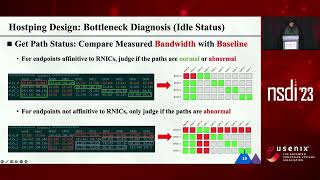 15mHostping: Diagnosing Intra-host Network Bottlenecks in RDMA Servers
 01h 24mPreview Session
 15mSecuring RDMA for High-Performance Datacenter Storage Systems
 25mResilience for AI Workloads at Scale: The Fast and the Finicky!
 14mODRP: On-Demand Remote Paging with Programmable RDMA