Status Update of COLO Project

summary
Coarse-grain lock‑stepping called COLO runs dual VMs simultaneously, compares response packets and only synchronizes when responses diverge, reducing checkpoints vs Remus and sending packets immediately instead of buffering; implements per-connection comparison, a 128ms coarse TCP timestamp and a window‑size quantization (round down to power‑of‑two or mask 8 LSB) plus deterministic segmentation to avoid divergence; adds a PV cache in Xen tablet to intercept reads/writes, uses event channels not xenstore, shows better WebBench/pgbench throughput and SMP scaling, patches upstream and Huawei plans FusionSphere use, split‑brain handling remains unresolved.
AI-written summary · about
chapters (20)
- 0:00Intro
- 0:40What is COLO
- 1:39How COLO works
- 2:42COLO vs Remus
- 5:28Existing approaches
- 6:31DurieMRS
- 8:45COLO Picture
- 9:39Current State
- 10:13Optimization
- 12:31Window Size
- 13:41deterministic segmentation
- 14:49storage
- 17:11memory sync
- 18:24checkpoint
- 19:05webbench
- 20:23question
- 20:58benchmark
- 21:38PGbench
- 22:01upstream
- 22:45summary
related talks
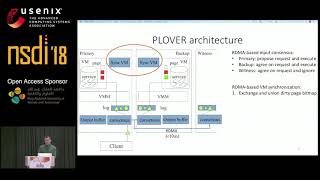 24mPLOVER: Fast, Multi-core Scalable Virtual Machine Fault-tolerance
 36mKeynote: State of the Cephalopod
 12mConcordia: Distributed Shared Memory with In-Network Cache Coherence
 22mAn Open and Coherent Memory Centric Architecture Enabled by RISC V
 31mUnshackling Memory!
 49mResponding in a Timely Manner
 20mAn Automated Scalable RISC-V Cache Coherency Verification Project
 16mState-Compute Replication: Parallelizing High-Speed Stateful Packet Processing