CacheSack: Admission Optimization for Google Datacenter Flash Caches
summary
CacheSack is an admission optimizer that partitions traffic by key groups, measures per-category cache benefit with a ghost table, and solves a knapsack formulation with fractional policies to pick per-category admission (never, always, LARC, etc.). Implementation runs decentralized on each index server every five minutes, uses retention-time buckets, and deployed experiments show a 6.5% improvement in total operational cost versus prior static policies while cutting disk reads and flash wear. The system is called CacheSack and runs in production.
AI-written summary · about
chapters (15)
- 0:00Intro
- 0:25Colossus Flash Cache
- 2:26Write amplification
- 4:01Write endurance
- 4:57Caching warm data
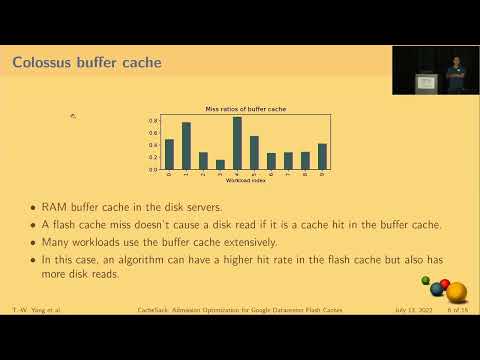
- 5:50Colossus buffer cache
- 6:55CacheSack model
- 8:33Model an LRU cache
- 10:13Knapsack problem
- 11:19Optimize over cache retention times
- 12:14CacheSack in Production
- 13:04Lessons learned
- 14:18Production experiment
- 14:42Experiment result
- 15:29Conclusion
related talks
 25mDistCache: Provable Load Balancing for Large-Scale Storage Systems with Distributed...
 21mDistCache: Provable Load Balancing for Large-Scale Storage Systems with Distributed Caching
 37mMemSweeper: Virtualizing Cluster Memory Management for High Memory Utilization
 10mLightning Talk: KV-Cache Centric Inference: Building a State-Aware...
 38mSecuring Distributed Cache: Achieving Secure-by-Default with Key Challenges &...
 43mCaching half a billion user transactions
 19mBeyond the Node: Scaling Inference with Cluster-Wide KVCache...
 21mSvalinn: Overload Control in Large-Scale Servers with Multiple Resource Bottlenecks