Proactive Energy-Aware Adaptive Video Streaming on Mobile Devices
summary
Integrates a user energy budget into ABR logic by adding a power predictor and controller to an MPC-based ABR with power predictor, implemented for 360° video on Pixel 2 and Moto Z3 and evaluated with real streaming traces. Proactive designs (look-ahead + look-back, plus smoothing) constrain cumulative energy per-chunk, reduce fidelity oscillation, saves 29.1% power versus unconstrained ABR, and yields up to 44.8% QoE improvement on Pixel 2 (19.2% on Moto Z3) under low power budgets.
AI-written summary · about
chapters (19)
- 0:00Intro
- 0:27Modern Mobile Apps are Power Hungry
- 0:52Case Study: 360° Video Streaming on YouTube
- 1:39Energy-aware App Adaption
- 2:28Outline
- 2:50Classic Energy-aware App Adaptation: System-level
- 3:37Characteristics of Classic Energy-aware App Adaptation
- 4:32Reactive Adaptation Causes Oscillation
- 5:29Key Observation: Modern Apps Have Proactive Built-in Adaptation • Built-in adaptation: Apps proactively adapt data fidelity to network dynamics or other system constraints to optimize QoE
- 6:04Key Idea: Proactive Energy-aware Adaptation
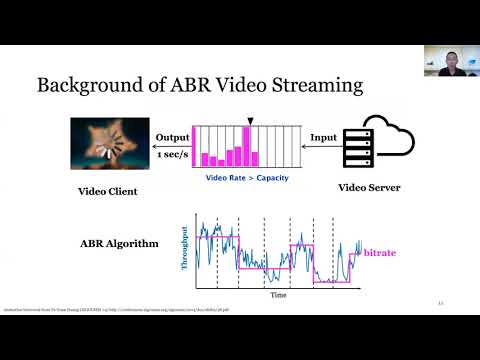
- 6:50Background of ABR Video Streaming
- 7:30ABR Problem Formulation [Sigcomm'15]
- 9:35Challenges of Proactive Energy-aware ABR
- 11:46Trace-driven Evaluation
- 12:10Impact of Different Proactive Design Options under Low Power Budget on Pixel 2
- 12:44Performance Comparison between Reactive and Proactive Approaches
- 13:21QoE Breakdown Comparison between Reactive and Proactive Approaches
- 13:44Generalization
- 14:15Summary
related talks
 17mPredict, Prune, Play: Efficient Video Playback Optimization Under Device...
 22mProviding better video experiences for the next billion users.
 18mOn-device Video Playback Upsampling
 16mSwift: Adaptive Video Streaming with Layered Neural Codecs
 23mMachine Learning for ABR in production
 03mImproving ABR at Netflix
 13mSENSEI: Aligning Video Streaming Quality with Dynamic User Sensitivity
 18mAV1 for