Information Collection Through Strategic Agents
summary
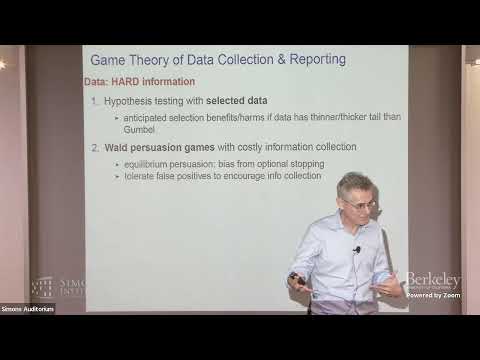
Papers present concrete game-theoretic models and sharp results: selective reporting of the top of K draws is often more informative than a random draw under log‑concave noise, with Gumbel as the neutrality boundary and exponential tails making selection harmful; sequentially, a biased agent acquires costly trials until optional stopping creates persuasion bias and a tradeoff where tougher approval reduces false positives but also discourages evidence and raises false negatives; forecasting contests yield equilibrium forecasts that strategically diverge from posterior means.
AI-written summary · about
chapters (14)
- 0:00Intro
- 1:05Economics of Statistics
- 3:38Impact of Sample Selection on Value of Information
- 7:45Illustration: Simple Hypothesis Testing
- 10:33Random Experiment
- 14:33Dispersion of Selected Experiment
- 25:57Wald Welfare Benchmark: Value Function
- 29:59Informer Authority Game
- 32:09Sequential Foundation of Bayesian Persuasion
- 33:432. No-Commitment "Nash" Outcome
- 35:57Evaluator Commitment Solution
- 39:34Honest Forecasting: Benchmark Statistical Model
- 43:49Excessive Differentiation in Forecasting Contest
- 45:28Forecasting Summary
related talks
 12mLearning In The Presence Of Strategic Agents: Dynamics, Equilibria, And Convergence
 25mReal Algebraic Geometry in Computational Game Theory
 19mTime To Resolve
 33mKarp Plays a Game
 06mDecoding the Maze: New Frontiers in Achieving Nash Equilibrium in AI Architectures
 15mTeamwork Makes The Von Neumann Work: Two Team Zero Sum Games
 22mPersonalizing Persuasive Strategies in Gameful Systems to Gamification User Types
 03mFacilitative Agents with Deliberate Handicaps in Traditional Competitive Games for Improved Playa...