BERT Model for Real World Healthcare Data

summary
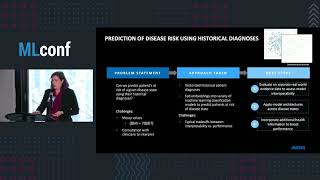
A modified BERT model adapts to electronic health records by turning visits into tokens and adding temporal positional encoding to handle sparse messy data with ~16,000 ICD-10 codes and noisy measurements, then trains with MLM and next-token prediction to learn visit sequences; results produce patient and disease embeddings that reveal cohorts and co‑morbid graphs, experiments explore Siamese BERT and embeddings for classification, and work requires heavy cleaning, clinical domain expertise and regulatory validation such as FDA approval.
AI-written summary · about
chapters (12)
- 0:00BERT in healthcare data
- 1:14Electronic health record data
- 2:59Processing healthcare data challenges
- 6:32Standard approaches fail for EHR
- 7:37Adapting BERT for non-textual data
- 9:03Language from EHR tokens
- 10:31Training BERT on sequences
- 11:59Siamese BERT for patient insights
- 13:02Latent space for medical conditions
- 14:27Explaining model results
- 15:32Healthcare AI key takeaways
- 16:57Q&A
related talks
 26mNatural Language Processing for Healthcare: Current Trends...
 23mLeveraging Generative AI and Transformers in Healthcare
 20mIntroduction of MedModels
 20mDiagnostic Medical application of ML
 33mLessons Learned Applying Large Language Models in Healthcare
 19mAddressing Treatment-Relevance in Biomedical Relation Extraction
 16mMedQGraph: TMKGs for AI-Driven Healthcare Insights
 32mGraph-based ML for Automated Health Care Services