Graph-based ML for Automated Health Care Services

summary
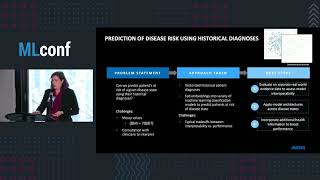
Evolving patient stays map to property graphs of four event types (fluids in, fluids out, labs, drugs) ingested with PGX and P-GQL and explored in Oracle Labs Data Studio. Admission timelines split into two-hour chunks and encoded by an RNN; nearest prior admissions come from a disease–symptom knowledge graph via weighted personalized PageRank. Neighbor diagnosis vectors concatenate with the admission encoding to predict diagnoses online on ~46k MIMIC patients, improving a baseline ~85% accuracy by about 1%.
AI-written summary · about
chapters (16)
- 0:00Graph-based ML in healthcare
- 1:13Model data as a graph
- 3:05Graph modeling for healthcare
- 4:10Technologies for graph analytics
- 6:55Demo setup with Oracle Data Studio
- 7:39Querying healthcare data
- 9:50Visualizing patient data
- 11:16Knowledge graphs background
- 14:06Healthcare knowledge graph structure
- 16:33Diagnosis prediction objectives
- 18:01Cajun model architecture
- 21:29Knowledge graphs in models
- 24:40Validation on MIMIC dataset
- 27:53Conclusion and future apps
- 28:55Technologies and resources
- 30:59Q&A on performance
related talks
 16mMedQGraph: TMKGs for AI-Driven Healthcare Insights
 17mEnhancing Benefit Adjudication Through Graph Node Embedding, Clustering, and Outlier Detection
 28mRole of Knowledge Graphs in Mental Health Diagnosis and Cure
 20mDiagnostic Medical application of ML
 10mTransforming Population Health with Predictive BI
 01h 04mGraph Theory for Multi-Agent Integration: Clinical Use Cases
 29mStay or Go? Predicting Customer Churn through Graph Relationships
 59mArtificial intelligence in Healthcare