Traditional & Novel Feature Selection Approaches
summary
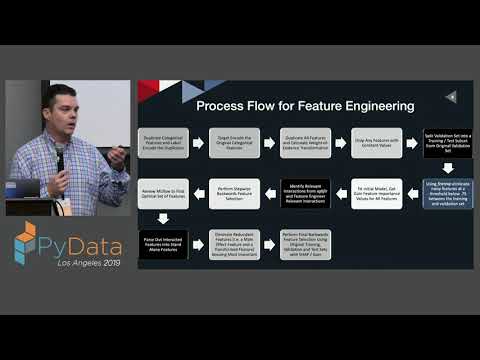
Claims that combining fast gain-based pruning with final SHAP-backed backward selection and a split validation subset improves model generalization and gives measurable lift. Uses the Lending Club dataset (≈188,000 loans, ~15% defaults) and tools: XGBoost gain, SHAP values, h2o AutoML, plus xgbfir, featx and MLflow. Builds a pipeline with label/target encoding, weight-of-evidence transforms, automated two/three-way interaction discovery, and stepwise elimination. Results show best run AUC ≈0.674, average precision 0.251 and ~10% lower log loss versus simpler selection, so the hybrid workflow empirically works on this finance dataset.
AI-written summary · about
chapters (12)
- 0:00Feature selection research intro
- 1:59Reconsider traditional attribution
- 3:26Data prep and setup
- 6:54Avoid data leakage
- 8:20FeatExpert for noisy features
- 10:05Speed vs accuracy balance
- 11:53Detecting feature interactions
- 14:05Five feature selection experiments
- 16:32Optimal feature counts
- 19:50Model performance comparison
- 23:03Key takeaways
- 27:24Q&A
related talks
 27mFast, intuitive feature selection via regression on Shapley values
 35mSHAPtivating Insights: unravelling blackbox AI models
 29mOpeningTheBlackBox
 35mTaking a peek under the hood - Interpreting black box model
 31mBeyond the Black Box: Interpreting ML Models with SHAP
 34mRethinking Feature Importance-Evaluating SHAP & TreeSHAP for Tree-Based MLM
 39mMachine Learning in Financial Credit Risk Assessment
 34mSynergizing model and human decision-making using augmented machine learning