Solving Forecasting Problems in R and Python

summary
Shows a concrete workflow: compare about seven R and Python packages, implement a hidden‑state decomposition that separates loyal vs transient customers, fit it with Stan, and validate by withholding future ticks. Coefficients for two external regressors are estimated at ~13.6 and ~16.0 against true 14.2 and 16.1, so the model works and outperforms generic ARMA-style fits while giving actionable decomposition and calibrated uncertainty.
AI-written summary · about
chapters (17)
- 0:00Welcome
- 0:22Motivation for forecasting
- 2:32Defining forecasting
- 5:48Temporal data and evaluation
- 7:17Traditional model challenges
- 10:49Forecasting methodologies
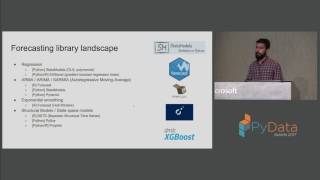
- 12:13Available tools survey
- 13:41ARMA and derived models
- 15:27Brute force forecasting
- 16:51Decomposition and hidden state
- 19:18Bayesian inference with Stan
- 20:20Problem setup example
- 22:50Customer modeling
- 24:36Stan results and evaluation
- 25:56Stan code details
- 26:16Business forecasting structure
- 27:03Q&A
related talks
 42mRobust Automated Forecasting in Python and R
 42mRobust Automated Forecasting in Python and R
 01h 40mApplied Time Series Econometrics in Python and R
 29mTime Series Forecasting Techniques in Python
 01h 26mApplying Statistical Modeling & Machine Learning to Perform Time-Series Forecasting
 59mPredictability Check: Demand Forecasting
 41mReliably forecasting time-series in real-time
 40mMulti-Series Forecasting at Scale with StatsForecast