Robust Automated Forecasting in Python and R
summary
Claims an automated pipeline that runs 2.6 million forecasts in ~5 hours by profiling and imputing daily panels, truncating incomplete seasons, detecting outliers, applying log/Box‑Cox transforms, and comparing ARIMA TBATS BSTS and regression approaches with concrete meta‑metric selection (MFE+RMSE). It chooses Python 3 beats Python 2, drops slow or redundant strategies, enforces a 300s timeout on long fits to regain 10% speed, and selects compute‑optimized EC2 with spot instances ~40% cost savings to meet runtime and cost targets.
AI-written summary · about
chapters (16)
- 0:00Introduction
- 1:25Time series data
- 2:30Problem definition
- 4:36Pre-processing data
- 9:59Detecting outliers
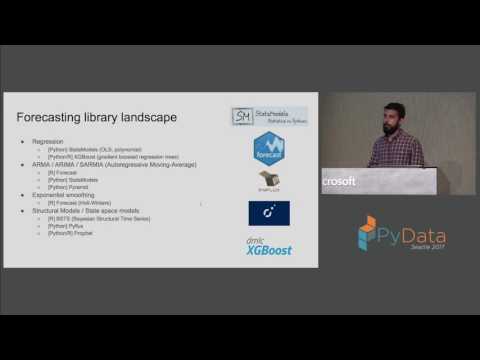
- 10:21Forecasting models
- 12:34Evaluating quality
- 14:24Optimizing runtime
- 23:48Python versions
- 25:14Hardware selection
- 26:20Reducing overhead
- 32:06Forecasting pipeline
- 32:28Scaling with Docker
- 35:11Cost optimization
- 36:36Future improvements
- 38:03Q&A
related talks
 29mSolving Forecasting Problems in R and Python
 40mMulti-Series Forecasting at Scale with StatsForecast
 41mReliably forecasting time-series in real-time
 01h 26mApplying Statistical Modeling & Machine Learning to Perform Time-Series Forecasting
 29mTime Series Forecasting Techniques in Python
 34mTime series for scikit-learn people
 35mBuilding a successful inventory planning solution with Amazon Forecast
 01h 40mApplied Time Series Econometrics in Python and R