🧠🧹 Causality - Mental Hygiene for Data Science
summary
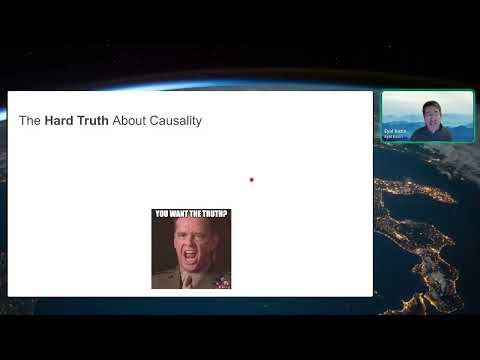
Claims that assessing whether causality applies yields value even if full causal inference is infeasible, and that using concrete tools changes outcomes: the workflow uses causal graphs (DAGs) and an identifiability framework, plus causal discovery to build those DAGs. A case shows a model with a 0.8 predictive score where a benchmark feature explains correlations and hides a weaker direct effect, and drawing the DAG clarifies which covariates to control for and improves interpretation and team decisions.
AI-written summary · about
chapters (13)
- 0:00Introduction to causality
- 1:50Why causality matters
- 3:16Causal inference challenges
- 6:26Smoking and lung cancer
- 9:16Resolving ML paradox
- 12:30Causal graphs
- 15:43Manual discovery with ice cream
- 18:57Parameter control and correlations
- 19:40Identifiability framework
- 22:52Reducing experiment budgets
- 24:18Key takeaways
- 26:05Recommended resources
- 27:10Q&A
related talks
 01h 06mThe New Science of Cause and Effect
 01h 01mThe Mathematics of Causal Inference, with Reflections on Machine Learning and the Logic of Science
 43mA Practical Guide to Causality in Python (For The Perplexed)
 45mCausality and Statistics, a Love Not So Impossible After All
 06mCausal Machine Learning – What’s in it for Data Scientists?
 41mOn the Path to Causal Inference
 01h 06mIntroduction to Causal Graphical Models: Graphs, d-separation, do-calculus
 28mCorrelation Sucks - Long Live Causality! Mastering Causal Inference in Data Science