Measurement of Trust in AI
summary
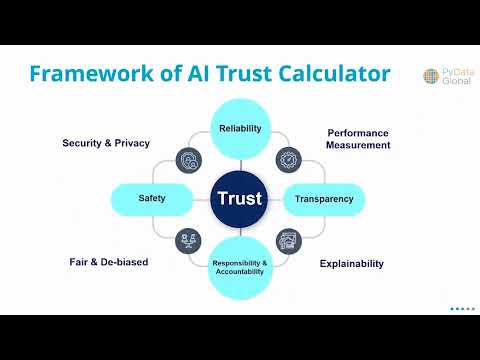
A concrete framework claims trust = four pillars (reliability safety transparency responsibility and accountability) mapped to performance fairness explainability and security and ships as an open source AI Trust Calculator built with Python, Spark and subex hypersense. It ingests train and validation sets and a pickle model (they demo a logistic regression churn model), runs 13 performance checks, 5 explainability and 10 security tests, simulates evasion and poisoning detected, finds no drift and yields a 51 trust score versus a suggested 80 threshold.
AI-written summary · about
chapters (9)
- 0:00AI trust measurement intro
- 1:08Trustworthy AI for adoption
- 3:39AI trust framework pillars
- 8:35Introducing AI Trust Calculator
- 13:11Churn prediction demo
- 16:22AI Trust Calculator guide
- 22:50Adversarial attacks evaluation
- 27:26Security and privacy results
- 30:14Future of AI trust
related talks
 26mThe Trust Problem: Designing Quality Frameworks for AI-Generated Code
 46mCan you trust your AI?
 26mHow can I trust you AI and the leap of faith
 19mCan you trust your AI?
 32mHow to Build Trustworthy AI with Open Source
 15mSuccessfully Scaling AI and the Role of Trust
 41mFostering Trust via Explainable ML Inferences
 37mBuilding a case for Fair and bias-free AI