Trust, Track, and Verify: Securing AI Pipelines End-to-End

summary
A live demo shows a pet-behavior classifier that is poisoned, then protected end-to-end by an SPDX 3.1 sbom that encodes dataset lineage and hashes plus model signing via Open Model Signing to attest model integrity. A policy engine ties dataset SBOMs and model signatures to CI/CD so training or image builds fail when hashes or attestations don’t match. The prototype works for the first two gates (data and model signature), uses JSON-LD graphs for provenance, and leaves signer identity and deeper checks as next steps.
AI-written summary · about
chapters (10)
- 0:00AI governance and security
- 3:31Shared responsibility in AI governance
- 8:07SPDX and AI bill of materials
- 10:23Demo setup
- 11:50Data poisoning attack demo
- 13:39Protecting data with SPDX SBOM
- 15:46Securing model training
- 17:32Model signing for inference
- 20:46Deepening model integrity
- 21:51Summary and future
related talks
 19mWe Know Security but How Do We Secure GenAI End-to-End?
 19mSecuring AI Pipelines from Development to Production
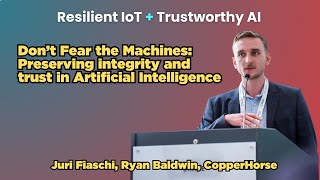 17mPreserving integrity and trust in AI
 33mAI sovereignty, provenance and compliance
 21mEnd-to-end secure ML Development
 18mCommit Secure AI: Embedding Security in Code, Pipelines, and Production
 31mBuilding Trust in ML: Mapping the Model Lifecycle for ML Integrity and Transparency
 19mModel transparency for AI/ML security