ML and DL in Production: Differences and Similarities
summary
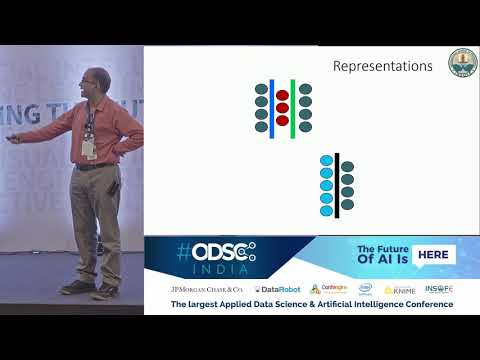
Compares practical production differences between traditional machine learning and deep learning, focusing on data strategies (feature engineering vs. large-volume tagging and synthetic data), hyperparameter tuning trade-offs given DL’s longer training times, and the role of transfer learning. Also examines common error-analysis practices and methods to detect and mitigate learned biases in highly non-linear deep models, offering a practitioner-oriented framework with examples.
AI-written summary · about
chapters (13)
- 0:00Start
- 3:59What made this possible?
- 13:20Every categorical attribute can be embedded
- 18:11We learned to represent categorical attributes better as vectors
- 27:10Inclusive architectures
- 29:17Lego blocks: Context the ML way
- 32:08Lego block architectures: LSTMS
- 34:31Lego block architectures: Translations: Sentiment analysis!!, inter system architectures
- 37:22Lego block architectures: Face identification
- 38:17Transfer learning: Exploiting the general to specific feature learning
- 39:33What else is the model learning?
- 43:04We are beginning to map problems from one domains to other
- 47:09Faculty summary
related talks
 06mMachine learning is about your data and deployment
 16mDeep Learning in Production Seen by a Data Engineer
 25mML in Production–What does “Production” even mean?
 21mWhy is Production ML so Hard?
 30mThe State of Production Machine Learning in 2023
 52mThe ML Lifecycle in Combat Conditions
 10mConsiderations for maturing AI initiatives from PoC to Production
 29mDemystifying Machine Learning in Production: Reasoning about a Large-Scale ML Platform