MemMachine: Agents That Learn, Memory That Lasts

summary
Introduces MemMachine as an open-source memory layer that uses a Neo4j graph backend for episodic, factual, semantic and profile memory and claims portability across models and providers. Implementation is a Python microservice (MemMachine) plus a Rust fallback (MemLight) that writes markdown + SQLite so data syncs via files; MemBox provides a GUI. Live demos show retrieval works (name and city returned) but chatty captures require routing rules and pruning; Neo4j scaling and private, user‑owned memory are central design goals.
AI-written summary · about
chapters (15)
- 0:00Introduction to MemMachine
- 1:04Three layers of AI memory
- 4:16Context in human and AI memory
- 8:27Memgraph’s memory buckets
- 9:31First demo with Memgraph
- 12:20Improved memory handling
- 15:11System prompts and context templates
- 17:43AI agents and memory needs
- 19:05Privacy and lock-in issues
- 20:09MemMachine architecture
- 21:11The Bob problem and graph databases
- 22:55APIs and multi-model support
- 23:36Introducing MemLight
- 24:38Second demo with MemoryBox
- 25:56Q&A session
related talks
 28mAgentic Memory
 18mArchitecting Agent Memory: Principles, Patterns, and Best Practices
 47mAgents and Memory Architecture
 15mBuilding Evolving AI Agents Via Dynamic Memory Representations Using Temporal Knowledge Graphs
 01h 49mBuilding Memory Augmented Agents with MemoRizz
 46mThe Anatomy of Memory in Humans and AI Agents
 27mMemory Engineering: Going Beyond Context Engineering
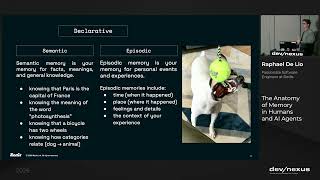 54mThe Anatomy of Memory in Humans and AI Agents