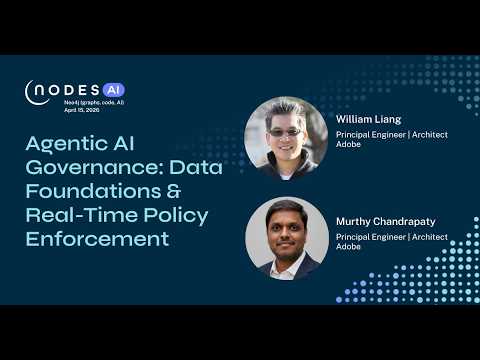
Agentic AI Governance: Data Foundations & Real-Time Policy Enforcement
summary
Adobe migrates PAS from Cosmos DB to a Neo4j property-centric graph, exploding properties into first‑class nodes to enable targeted traversals that prune irrelevant subgraphs, producing much faster reads at the cost of careful write management (write amplification, serialization, leader latency). An agentic workflow uses schema-aware prompting and Claude + LangGraph + Neo4j to generate and execute Cypher, decomposing queries into multiple steps, enforcing tenant scoping (zero cross‑tenant leakage), and returning human explanations; demo shows multi‑query inspections and ~65 relationships analyzed.
AI-written summary · about
chapters (14)
- 0:00Introduction to AI governance
- 1:04What is data governance
- 2:30Policy Enforcement Service challenges
- 4:17Migrating to Neo4j paradigm shifts
- 9:16Building agentic AI workflows
- 13:29Live demo of agent workflow
- 16:19Q&A on Cypher and schema
- 20:00Robustness and scalability challenges
- 22:43Graph schema and hierarchical knowledge
- 25:16Evaluating graph schema effectiveness
- 26:43Exploding data model explained
- 29:02Indexing and trade-offs
- 30:06Agent reasoning and context maps
- 31:52Closing and Q&A wrap-up
related talks
 08mHarness Graph Power With Agentic AI: An Insights Discovery Use Case
 12mLeveraging Neo4j Graph Data and AI Across the App Development and Deployment Lifecycle
 29mAgentic GraphRAG: Multi-Agent Knowledge Graph Construction for Research Teams
 15mAgentic GraphRAG: Simplifying Retrieval Across Structured & Unstructured Data
 12mRevolutionizing Platform Engineering with AI Agents and GraphRAG
 30mLive-Coding Graph-Native Agents: Neo4j AuraDB + Microsoft Agent Framework in Action
 30mAgentic RAG with Knowledge Graphs Explained
 29mTransparent Multi-Agent AI