Petrinets: What are they? How can they help us?

summary
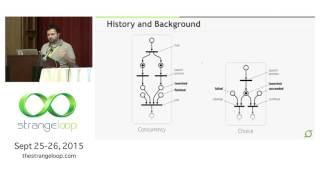
Defines Petri nets as directed bipartite graphs with places, transitions and tokens and gives the actual math: incidence matrix, marking vectors and extensions for inhibitors, reset arcs, time windows and colored tokens. Presents a working C++ simulator that loads JSON models, uses an agent scheduling policy, records transition firings and computes the reachability graph to detect unbounded places (omega). Measures performance difference between recording and nonrecording runs and reports it is fast enough for practical use.
AI-written summary · about
chapters (12)
- 0:00Introduction
- 2:30System Design
- 4:07Design Phase
- 8:29Graphical Representation
- 11:10Incident Matrix
- 14:46Events
- 27:04Relational marking
- 29:49Time
- 31:57Token
- 33:53Simulation
- 36:45Tools
- 37:29Simulations
related talks
 43mPTero: Architecture and Development
 29mThinking in Graphs – An Intro to Graph Databases & Applications
 45mConnecting the dots to go from tabular security incident data to behavioral graph understanding
 28mGraphs + Sensors = The Internet of Connected Things
 51mMemory Masterclass: Make Your AI Agents Remember What They Do!
 14mA Practitioner's Guide to Graphs
 23mImpact assessment with Netbox Path
 19mUnraveling the Web of Relationships: Understanding Graph Data