Spinning Icons: Introducing a Novel SSVEP-BCI Paradigm Based on Rotation

summary
Introduces a new SSVEP paradigm using spinning icons—icons rotated around their vertical axis at 7.5, 10, or 13 Hz—and tests it with a g.Nautilus EEG headset using Oz as the active channel and filter-bank CCA offline classification. Ten usable participants yield roughly 70–75% balanced accuracy (PDF icon peaks at 75% balanced accuracy), 7.5 Hz shows presentation issues, and subjective ratings report lower visual fatigue than motion-based stimuli. Implementation works in lab conditions and invites online and icon-variation followups.
AI-written summary · about
chapters (8)
- 0:00Introduction
- 0:21SSVEP
- 2:05Background
- 4:41Experimental Procedure
- 6:17Results
- 7:51Evaluation
- 8:51Visual Fatigue
- 10:01Conclusion
related talks
 24mDelightful UI Animations by Understanding the Brain
 20mEdgeVib: Effective Alphanumeric Character Output Using a Wrist-Worn Tactile Display
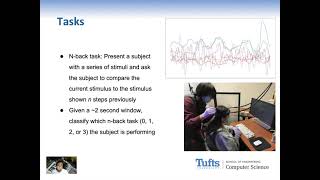 09mTaming fNIRS-based BCI Input for Better Calibration and Broader Use
 19mNew Tools for Old Problems
 34mReading Thoughts with JavaScript
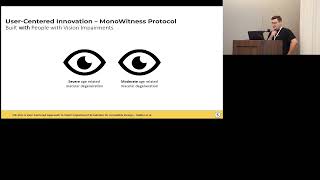 11mVIP-Sim: A User-Centered Approach to Vision Impairment Simulation for Accessible Design
 21mHands-Free Coding With Gaze Control in JavaScript
 18mOrbits: Gaze Interaction for Smart Watches using Smooth Pursuit Eye Movements