An Activity Recognition System for Taking Medicine Using In-The-Wild Data to Promote Medication ...

summary
An activity recognition system uses Polar M600 smartwatches (both wrists) and an Android app to collect inertial data from 9 participants, extracts 106 features reduced to 50, and trains a modified bagging with enforced skew (2–10% minority) plus stacking on a prediction-probability portfolio. User-independent generalization is poor, user-adaptive tuning improves results, and the final pipeline reaches about a 0.77 F-measure for detecting medication-taking from in-the-wild data, showing feasibility with large per-user variability.
AI-written summary · about
chapters (15)
- 0:00Start
- 0:15INTRODUCTION
- 0:57HUMAN ACTIVITY RECOGNITION
- 1:33RESEARCH GOALS
- 3:47DATA COLLECTION
- 3:58USER STUDY
- 4:17BASELINE MODEL
- 4:45EXP 1: CONTROLLED BAGGING
- 5:25EXP 1: BASELINE PERFORMANCE
- 5:54EXP 1: USER-DEPENDENT MODEL
- 6:16EXP 1: USER-DEPENDENT + USER- ADAPTIVE TUNING
- 6:36EXP 2: PORTFOLIO CLASSIFICATION
- 7:03EXP 2: BASELINE UPDATE
- 8:20INTELLIGENT MEDICATION ADHERENCE INTERFACES
- 8:33REFERENCES
related talks
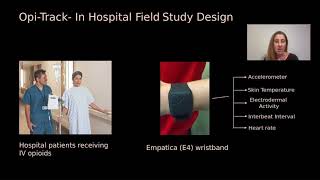 06mOpiTrack: A Wearable-based Clinical Opioid Use Tracker with Temporal Convolutional Attention ...
 18mFitness motion recognition with Android wear
 27mDissecting ActivityRecognition with Multi-Sensor Simulation and Its Practical Deployment
 06mUser-Based Collaborative Filtering Mobile Health System
 17mTransforming Medical Records Into a Heart Attack Prediction Model
 01h 04mTake Control of the Data of You
 01h 13mHealth Monitoring with Wireless Sensors and Machine Learning
 14mDoes fitness data make the average person healthier?