From Black Scholes to Black Holes

summary
Uses symmetry groups (Schrödinger, 2D conformal, Lifshitz) to derive explicit two‑point option pricing kernels and a nonlinear Black‑Scholes family determined up to a cross‑ratio, obtained via null/spatial reductions (partial Fourier transforms) from a 3D conformal theory. Claims a holographic embedding where nonlinear, fractional boundary dynamics map to linear bulk PDEs, and financial crashes map to collapse to a bulk black hole, producing an analytic crash model that matches fast onset/slow evaporation behavior seen in March 2020 and reproduces volatility skews via RG.
AI-written summary · about
chapters (7)
- 0:00Introduction to econophysics
- 1:36Symmetry and finance
- 5:11Group theory in market modeling
- 12:39Symmetry group interplays
- 15:20Holography in finance
- 24:50Gravity and non-linear theories
- 28:04Black hole physics for crashes
related talks
 35mCan financial crashes be anticipated using physics?
 01h 15mEducational framework for Black Box optimization methods design
 01h 09mExact Holographic Mapping and Emergent Space-time Geometry
 01h 03mSampling Crash Course (continued)
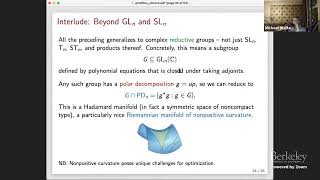 01h 11m(Hidden) Symmetries of Computational Problems (continued)
 01h 07mOptimization Crash Course (continued)
 01h 14mSampling Using Diffusion Processes, from Langevin to Schrödinger
 01h 11mOptimization and Sampling Under Symmetry: Part 1 -- Examples