Trust Cards For AI

summary
Argues for expanded data and model identity cards that record robustness, explainability, fairness, privacy and operational KPIs rather than just accuracy; demonstrates a lab-built blackbox evasion library that generates realistic adversarial network traffic and is used for adversarial training to harden intrusion-detection models; surveys tooling for explanations and defenses—SHAP LIME Captum, ART/CleverHans, ALB detect—and privacy-preserving runtimes including TensorFlow Privacy, Microsoft SEAL, Concrete ML and an Enigma prototype that runs neural nets on encrypted data; cites ISO AI standard (Dec 2023).
AI-written summary · about
chapters (14)
- 0:00Trust Cards for AI introduction
- 1:11AI fundamentals in cybersecurity
- 8:21AI lifecycle security challenges
- 13:23AI attack types and countermeasures
- 17:24Secure AI development research
- 20:36Trust Cards for AI models
- 23:07AI trust and security metrics
- 27:03AI robustness testing
- 28:28AI explainability tools
- 30:17AI fairness and bias mitigation
- 32:04AI privacy and cryptography
- 34:15AI Trust Cards requirements
- 35:19AI governance and collaboration
- 38:33Closing remarks
related talks
 44mComputers are Stupid: Protecting "AI" from Itself
 30mTrustworthy AI - opening up the black box
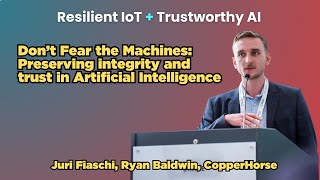 17mPreserving integrity and trust in AI
 18mCommit Secure AI: Embedding Security in Code, Pipelines, and Production
 19mWe Know Security but How Do We Secure GenAI End-to-End?
 35mHacking AI Systems: How to (Still) Trick Artificial Intelligence
 48mStay Ahead of Adversarial AI in OT/ICS Environments – Mitigating CWE-1039
 01h 05mNavigating the Security and Privacy Landscape of Modern AI