Web-based Tools and IDEs: Accomplishments and Opportunities
summary
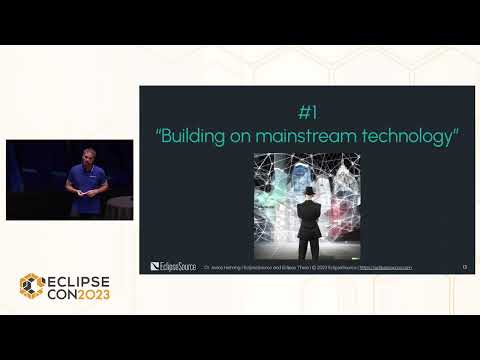
Web-based tools become the standard: about 90% of new tools are web-based but under 50% are actually deployed in the cloud, because teams often ship Electron desktops first. Accomplishments: cloud-ready architectures, a tool UX reset (modern theming, zoom, animations, keyboard focus), and mainstream stacks like HTML/TypeScript/React and Eclipse Theia. Surprises and opportunities: per-user backends consume 0.5–2 GB, collaboration models (beyond Live Share) are scarce, URL-based preloaded IDEs and a backend-less Theia (browser FS, Langium running client-side) point the way to cloud-native, shared-index designs.
AI-written summary · about
chapters (10)
- 0:00Web-based tools and IDEs intro
- 2:57Seven years of accomplishments
- 6:02Tool UX after migration
- 9:14Building with web tech
- 12:25Future opportunities for IDEs
- 13:50Collaboration in IDEs
- 15:55Cloud-native IDE integration
- 19:26Cloud-native tool architecture
- 24:23Open source in web tools
- 25:04Summary and outlook
related talks
 36mIf, when and how? - Strategies towards web-based tooling
 27mHow browser IDEs are enabling the transition of development to the cloud
 54mThe Future of the Web-Apps
 28mAchieving Economies of Scale in Cloud IDEs
 45mContaining Your Development – Why Cloud IDEs Are the Future
 34mBuilding Web-based Modeling Tools based on Eclipse Theia
 17mThe Future of Cloud Development is Editor Neutral
 37mTextual and Graphical Languages for the Cloud Era