Hacking the Blackbox

summary
Argues that black‑box models are exploitable and those exploits can be turned into fixes: uses Adversarial Alignment to probe vision, sensor and LLM systems; tools include Segment Anything, stable diffusion inpainting and adversarial patches. Concrete failures: an EV vision reads a 35 sign as 85, an MNIST digit is misclassified as six at 99% confidence, replacing seals with boats yields ~50% boats flagged as seals, and an apple sticker makes a model call it broccoli. Process: attack, explain, align — collect adversarial cases, retrain or augment to improve out‑of‑domain robustness.
AI-written summary · about
chapters (15)
- 0:00Opening keynote
- 1:02Defining black box AI
- 2:49Numbers mislead AI decisions
- 4:35Black box model failures
- 6:20AI vulnerabilities demo
- 8:51Hacking language models
- 10:16Prompt injection tricks
- 12:25Hacking to explainable AI
- 13:28Marine life detection research
- 18:22Sleep tracking attacks
- 22:13LLM decision boundaries
- 25:25Attack explain align
- 27:08Red teaming AI evaluation
- 28:57Hacking a chatbot
- 30:21Q&A
related talks
 21mAdversarial Attacks
 35mHacking AI Systems: How to (Still) Trick Artificial Intelligence
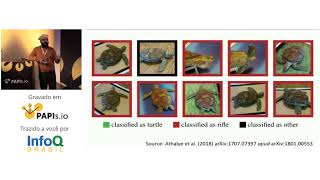 36mAdversarial Attacks on Deep Learning
 37mKeynote - Hacking AI How to Survive the AI Uprising
 46mA Short Introduction to Hacking Artificial Intelligence
 42mHow to attack AI systems (and how to defend them) !!!!
 20mAttacking and Defending Machine Learning Applications of Public Cloud
 38mUsing adversarial samples to robustify your Neural Network Models