Understanding Security Threats Against Machine/Deep Learning Applications

summary
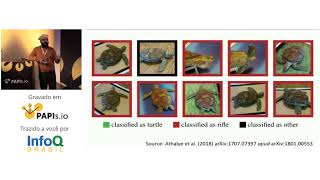
Covers practical attacker methods and concrete defenses: white‑box gradients (use of the fast gradient sign method and Jacobian saliency maps), optimization attacks that break many defenses (notably Carlini and Wagner), adversarial patches/toasts, membership‑inference via overfitting and influence functions, trojan/backdoor models delivered via model zoos or poisoned training data, and model extraction from prediction APIs. Notes scale (layers with 50–100 nodes, millions–billions of connections), transferability of black‑box attacks, and mitigations like adversarial training, dropout/regularization, ensembles and API rate‑limiting.
AI-written summary · about
chapters (18)
- 0:00Introduction
- 1:24Review of Machine Learning
- 5:53Example
- 12:25Adversary Inputs
- 14:17Neural Network
- 15:10Why is this important
- 16:45How does this work
- 18:52Neural Networks
- 20:25Whitebox vs Blackbox
- 22:38Differentials
- 23:25Derivative
- 28:15math
- 30:53fast gradient sign
- 33:40Jacobian map approp approach
- 39:56Carlini Wagner
- 45:10Genetic Algorithms
- 49:40Synthesising Data
- 52:07Adversary Patches
related talks
 53mSecurity of Machine Learning Systems
 36mAdversarial Attacks on Deep Learning
 21mAdversarial Attacks
 28mSecurity of Machine Learning
 36mAdversarial Machine Learning: How Secure Is ML?
 01h 01mData Security in Machine Learning
 44mAdversarial attacks on deep learning models
 20mMachine Learning Attacks – A New Era of Security Epidemic