Remote Exploitation of an Unaltered Passenger Vehicle
summary
A factory 2014 Jeep Cherokee with a vulnerable Uconnect head unit is remotely accessed via the infotainment Wi‑Fi or the car’s Sprint cellular IP, where an anonymous D‑Bus service exposes Lua methods allowing command‑injection and code execution. An unsigned OTA firmware image is backdoored to relay arbitrary CAN frames, enabling wipers, locks, speedometer spoofing, pre‑collision/brake and steering effects; scanning finds roughly 1.4M affected vehicles before a recall and patches.
AI-written summary · about
chapters (20)
- 0:00Introduction and setup
- 1:51Why remote car attacks matter
- 3:27Understanding vehicle attack surfaces
- 5:03Targeting the 2014 Jeep Cherokee
- 8:40Wi-Fi attack vector limitations
- 11:23Exploiting time-based Wi-Fi passwords
- 13:20Debug service and IPC vulnerabilities
- 17:07Remote code execution via Wi-Fi
- 20:47Moving beyond Wi-Fi to cellular
- 22:23Cellular attack feasibility
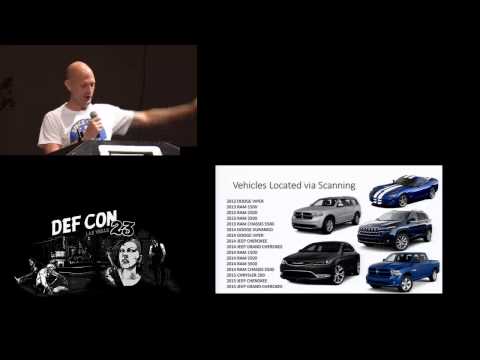
- 25:10Scanning for vulnerable vehicles
- 26:58Discovering 1.4 million vulnerable cars
- 29:08Bridging the air gap myth
- 31:17Firmware update and backdooring
- 34:27Exploit execution and CAN bus access
- 35:39Demonstrating live remote control
- 38:10Sending CAN messages to control car
- 40:10Practical remote attacks and payloads
- 43:04Responsible disclosure and recall
- 44:42Impact and future of car hacking