The Rise of Agentic AI and Its Transformative Potential

summary
Claims concrete performance gains: hierarchical planning yields about 45% higher success rates than flat planning on complex tasks; adding explicit semantic memory gives ~37% accuracy improvements in domain tasks; tool-enabled agents show nearly 3x success on information-gathering benchmarks; React beats alternatives by ~31% completion while plan-and-execute scores ~24% higher on consistency in structured domains. Multi-agent coordination improves completion ~37%. Embodied systems like SPAM RT1 RT2 report manipulation success comparable to specialized algorithms. Continual and meta learning cut training needs and boost long-run success by notable percentages.
AI-written summary · about
chapters (10)
- 0:00Introduction to Agent AI
- 1:17The Evolution of AI: From Text Generators to Autonomous Agents
- 2:47Technical Foundations of Agent AI
- 4:57Operational Frameworks: React and Plan-Execute
- 7:04Managing Autonomy and Ethical Considerations
- 8:23Multi-Agent Systems and Collaborative Problem Solving
- 9:50Embodied Agency: Connecting AI to the Physical World
- 11:28Continual Learning and Meta Learning
- 14:09Practical Applications and Ethical Challenges
- 17:11Future Directions and Conclusion
related talks
 28mAgentic AI
 34mAI Agents: Transforming Autonomous Decision-Making
 08mReal AI Agents Need Planning, Not Just Prompting
 16mBuilding Applications with AI Agents
 26mAI Agents and the Future of Human-AI Collaborative Intelligence
 29mAgentic AI: What It Is and Why It Matters
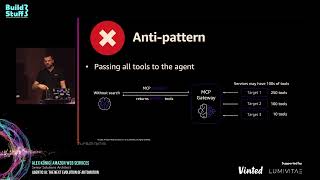 40mAgentic AI: The Next Evolution of Automation
 27mAgentic Engineering: Working With AI, Not Just Using It