Modeling Cancer Evolution from Genomic Data
summary
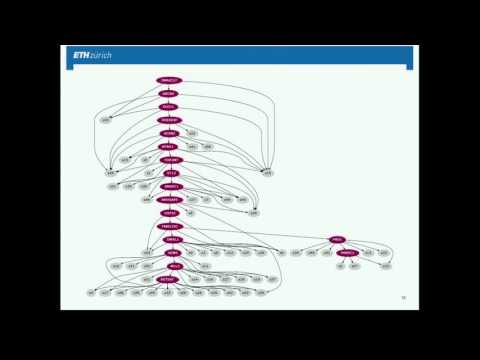
Single-cell phylogenies are reconstructed from noisy binary mutation matrices using an MCMC prune-and-regraft sampler that integrates out sample attachments, implemented as SITE; on 58 cells with 18 mutations (45% missing, FP≈1e-5, FN>40%) and 47 cells with 40 mutations (1.4% missing, FP≈1e-6, FN≈10%) the method yields stable linear-plus-branching mutation trees under the infinite sites assumption. A separate tool, PathTimeX, models pathway-level partial orders with exponential waiting times and mutual exclusivity, recovering canonical orders like APC→KRAS→TP53 and coherent glioblastoma pathway groups.
AI-written summary · about
chapters (22)
- 0:00Intro
- 0:19Cancer is an evolutionary process
- 1:00Clonal expansion
- 1:47Intra-tumor heterogeneity
- 2:30Some challenges
- 3:39Phylogenetic vs. oncogenetic models
- 5:07Intra-tumor phylogeny
- 7:57Observation error
- 8:35Likelihood
- 9:47Attachment of samples
- 11:48Single-cell sequencing of a myeloproliferative neoplasm (Hou et al., Cell 2012)
- 13:57Single-cell sequencing of an ER* breast tumor (Wang et al., Nature 2014)
- 20:06Partial order among pathways
- 20:45Individual progression
- 21:03Genotypes at diagnosis
- 21:27Waiting time distribution
- 22:09Hidden conjunctive Bayesian network (H-CBN)
- 22:43Can we find pathways de novo?
- 25:07Pathways and their dependencies
- 26:12Joint inference
- 26:32Progression in colorectal cancer
- 27:04Progression in glioblastoma
related talks
 55mExploring the Relationship Between Innovation and Catastrophe
 30mUnlocking the Genome: Exploring the Potential of CRISPR/Cas9
 58mStrong Generalization from Small Brains and No Training Data
 01h 11mThe Partition Function, Sampling and Equilibration in Physics
 01h 02mMarkov Chain Mixing Times and Applications II
 58mMarkov Chain Mixing Times and Applications III
 40mModeling Complex Interactions in Natural Systems
 01h 03mDecay of Correlations in Spin Systems