Exploring the Relationship Between Innovation and Catastrophe
summary
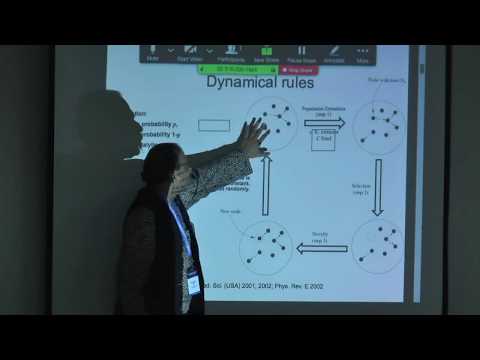
A stochastic model evolves a directed graph of S nodes (examples use S=100, link probability P≈0.005) with linear population ODEs: run to attractor, remove the least-populated node, and insert a randomly connected new node. Simulations produce phases of randomness, rapid growth and organized states, punctuated by crashes and recoveries; the largest eigenvalue jumps from 0 to ~1 when a cycle appears. Most crashes trace to two specific innovations: autocatalytic set formation that shifts the core (core-shifting innovation) or a peripheral cycle that later takes over (dormant innovation).
AI-written summary · about
chapters (9)
- 0:00Start
- 1:46Creative Destruction
- 13:18Adjacency Matrix
- 14:29Rules for Evolution
- 28:22Emotionally Random Graph
- 31:10How the Number of Links in the Graph Grows with Time
- 34:09Innovation
- 37:27The Performance Criterion
- 48:44Dormant Innovation