Interpreting Cancer Genomes with Network Knowledge
summary
Argument: genome sequencing alone cannot recover most cancer genes because mutations are rare per patient and sit in a long tail. A pipeline propagates per‑patient mutations over molecular networks to produce an information‑rich gene score vector, then clusters patients; applied to TCGA ovarian exomes it defines subnetwork clusters that stratify survival and validate on an independent ICGC cohort. Parallel work builds a data‑driven hierarchy (NeXO) from interaction, expression and synthetic‑lethal data to aggregate mutations into networkotypes that predict phenotype; mass spectrometry is used to expand the cancer cell map.
AI-written summary · about
chapters (11)
- 0:00Intro
- 1:09Massive DNA sequencing underway for cancer, approaching 10,000 genomes
- 1:43The challenge: Most tumor mutations are rare; completely different from patient-to-patient This situation does not fundamentally change as more patients are sequenced
- 5:37Genome analysis did not originally discover most known cancer genes
- 6:53Analysis of genome alterations cannot distinguish most known cancer genes from the genomic background
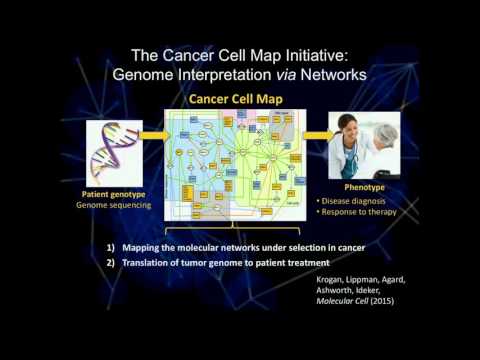
- 8:50The Cancer Cell Map Initiative: Genome Interpretation via Networks Cancer Cell Map
- 10:39Network-Based Stratification of Ovarian Cancer Consensus clustering of somatic mutations
- 14:51Networks govern patient survival & drug resistance
- 15:36Network aggregating low-survival OVCA patients ICGC mutation
- 20:44Gene networks do not directly capture modularity or scale A
- 22:24Building gene ontologies (NeXO method)