Reed-Muller and Other Subcodes of the Sierpinski Matrix
summary
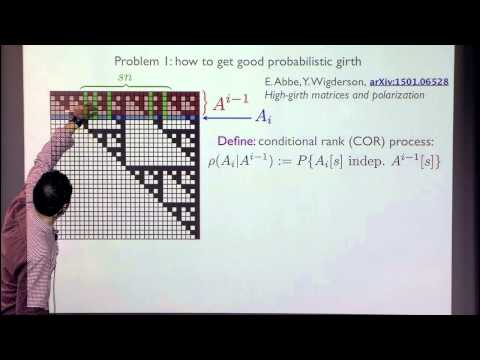
Reed–Muller rows are reinterpreted via the Sierpinski tensor and a polarization of conditional ranks to build explicit parity matrices that meet a probabilistic Girth criterion; that gives N log N constructions (field-agnostic) achieving capacity on the BEC in some regimes. Weight‑enumerator bounds push degree R up to about m / log m; hashing plus affine‑invariance and generalized Hamming‑weight results yield guarantees that selected columns avoid dependencies and even allow roughly √N‑scale error/erasure correction in the high‑SNR regime.
AI-written summary · about
chapters (8)
- 0:00Intro
- 0:36coding theory
- 4:28The Serpiensky matrix
- 8:18A proxy for the BEC error probability
- 11:37A code achieves capacity on the BEC
- 17:56The COR process
- 22:56Results for problem 2
- 29:05RM codes for BEC at high rate: high-girth property
related talks
 01h 14mPolar Codes III
 01h 19mTutorial 2: Algorithmic Invariant Theory
 57mComputing Multiplicities of Lie Group Representations
 39mStructure of the Fourier Spectrum of Boolean Functions and Complexity
 29mApproximating the Permanent of Positive Semidefinite Matrices
 10mOn the Generality of Matrix Multiplication
 23mKarchmer-Wigderson Games for Hazard-free Computation
 01h 01mTrue Complexity of Multilinear Systems