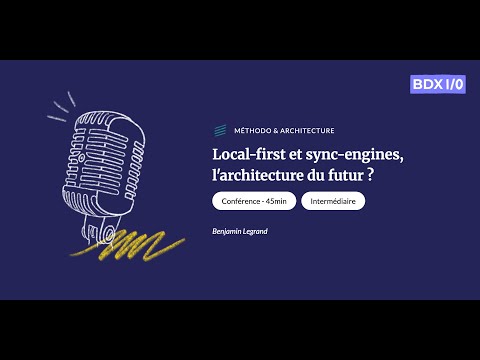
Local-first and Sync Engines, the Architecture of the Future?
summary
The talk explains the local-first application pattern and the synchronization engines that make it work, contrasting it with traditional request-every-interaction designs. It covers how local-first apps (examples: Linear, Figma, Trello) keep data primarily on the client, enable offline use and instant UI responsiveness, and use sync engines to reconcile and propagate changes. The talk also outlines core principles of local-first, describes what a sync engine does, and gives examples of libraries and databases that implement these approaches.
AI-written summary · about
chapters (8)
- 0:00Introduction
- 5:57Local-first principle
- 9:30Use cases and limits
- 14:06Service workers and PWA
- 16:52CRDT and conflict handling
- 23:12Paradigm shift
- 28:45Future and ecosystem
- 31:34Conclusion
related talks
 43mLocal-First and Sync Engines, the Architecture of the Future?
 41mThe UI/UX Benefits and Trade-Offs of Local-First Apps
 45mOffline First (Web) Apps
 52mMy Data Is My Data, or The Local-first Decentralized Web
 29mThe Future of Real-time | Offline | Data
 34mGet Your Head Out of the Cloud — Embracing Local-First Apps with Nuxt
 24mAn introduction to local-first apps
 47mThe future of Real-time/offline/data