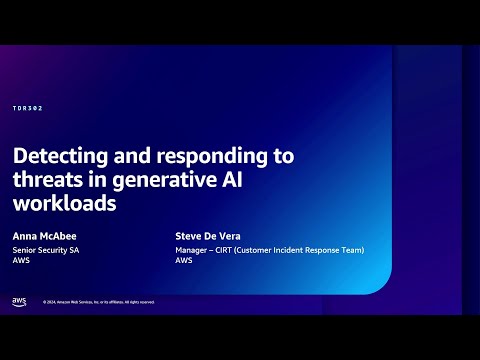
Detecting and responding to threats in generative AI workloads
summary
Framework for investigating Bedrock-based chatbots maps seven concrete signals—access, computing changes, AI changes, data store changes, invocation, private data, proxy—to CloudTrail, GuardDuty and Security Hub evidence plus host logs. Practical additions are enabling model invocation logs to capture prompts/responses to S3 (or CloudWatch), hunting for suspicious control-plane calls (AttachUserPolicy, CreateAccessKey, sts tokens) and surprising noisy artifacts like 22 RunInstances that indicate mass provisioning. Prioritize revoking creds, restoring models, and enforcing least privilege.
AI-written summary · about
chapters (18)
- 0:00Introduction
- 1:32GenAI security overview
- 3:46AWS AI services
- 6:06Shared responsibility model
- 7:51IR lifecycle foundations
- 9:12Types of AI security events
- 10:42Components of AI models
- 13:44Elements of AI IR
- 18:03Example incident: access
- 21:03Example incident: analysis
- 24:39Data plane investigation
- 27:12Actionable takeaways
- 29:09New logging sources
- 30:17CloudTrail vs. Bedrock logs
- 32:05Detection and containment
- 33:51Recovery and lessons learned
- 35:48Security fundamentals
- 38:46Resources and conclusion
related talks
 18mDefending the unknown using AI and cybersecurity
 24mHow to Build Trustworthy AI
 39mSecuring AI at Scale: Practical Defenses against Prompt...
 35mGenAI Application Security: Not Just Prompt Injection
 39mBuilding Safe AI Agents
 18mCommit Secure AI: Embedding Security in Code, Pipelines, and Production
 41mThreat Modelling for ML/AI systems
 09mSecuring Generative AI Workloads