When to Gen AI? A strategic framework for real-world AI adoption
summary
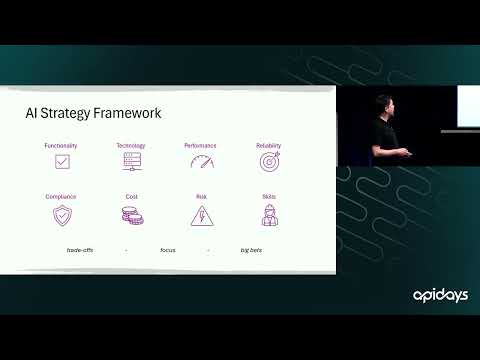
Argues a practical two‑axis decision frame: deterministic vs probabilistic and pre‑training vs runtime inference to decide where GenAI adds value. Claims generated code can keep runtime deterministic, while one LLM parameter shifts behavior along the spectrum. Notes transformers scale ~n^2 and training locks data but inference enables grounding, retrieval and chain‑of‑thought; calls out NVIDIA GPU lock‑in, high GPU costs and environmental footprint, hallucinations and compliance risk, and agentic systems that mix both approaches.
AI-written summary · about
chapters (15)
- 0:00Welcome to Gen AI adoption
- 1:50Humane AI Pin failure and limits
- 2:32AI in runtime solutions
- 4:20Training versus inference focus
- 6:45Where and when shape AI strategy
- 8:10Key dimensions for AI adoption
- 11:08Trade-offs in deterministic vs AI
- 13:12Performance and efficiency in AI
- 14:59Reliability challenges in AI
- 17:05Compliance in AI development
- 19:56Cost of AI training and inference
- 22:23Risk management in AI
- 25:19Skills shortages for AI
- 27:31Agentic AI and future approaches
- 28:14Strategic takeaways
related talks
 41mGenerative AI: bliss or miss?
 23mScaling GenAI Applications and Agentic AI for Business Competitive Differentiation
 11mOpen source GenAI vs. enterprise GenAI: Navigating the future of AI innovation
 26mGenerative AI: Impact of Responsible AI
 35mInnovating Teams Through Gen AI
 59mThe Strategic Answer to GenAI: Empirical Enterprise Evolution
 25mMaking AI Useful
 45mThe Curious Incident of Developing Artificial General Intelligence