Agentic AI Coding Practices for Speed with Quality
summary
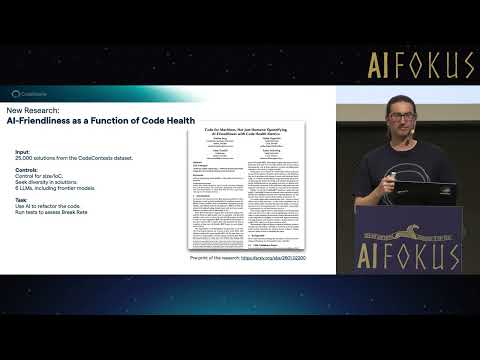
Claims that production work is fully agentic with 100% production code written by agents while measuring roughly 2–3x faster task completion. Independent studies show risks: a 600-developer experiment reports a 41% increase in defects, and a separate large study finds initial >200% velocity gains erode within two months because of AI‑induced complexity. A 1–10 code health metric requires ~9.5–10 for low AI break rates; average code scores ~5.15. An MCP server enforcing health plus 100% test coverage raises automated refactor success from ~50–55% to ~90–100% and cuts token spend 29–50%.
AI-written summary · about
chapters (17)
- 0:00Agentic coding practices intro
- 1:04Why agentic coding is harder
- 3:53Naive AI adoption risks
- 6:20Code health for AI success
- 9:34Code health boosts speed
- 10:59AI-friendly code metrics
- 13:25AI code quality issues
- 16:20Illusion of instant software
- 18:50Sustainable agentic coding criteria
- 21:17Making code AI-ready
- 23:02Agentic refactoring legacy
- 25:31Code coverage as KPI
- 29:27Trusting AI selectively
- 31:13Next frontier in agentic design
- 34:41Token efficiency costs
- 36:06Key takeaways and future
- 37:15Q&A on TypeScript, tests, MCP
related talks
 16mCoding Reinvented How AI Agents Are Shaping the Future of Software Development
 44mSpeed Is Easy, Trust Is Hard: AI's Real Impact on Developer Productivity
 40mCode Rot at Machine Speed: Preventing AI-Induced Technical Debt
 26mAI Agents as Your Co-Developer
 18mHumans + AI: The Future of Software Development Teams
 21mAI Code Quality Debt: What Strong Engineering Teams Do Differently
 46mMeasuring the Impact of AI on Developer Productivity
 27mSoftware engineering with GenAI