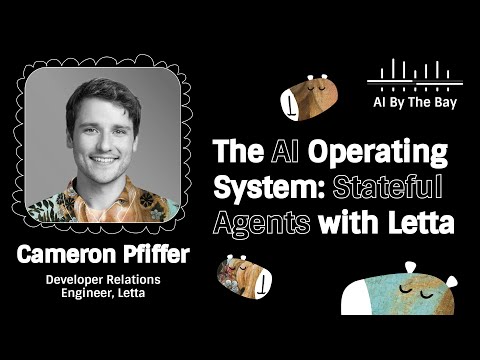
The AI Operating System: Stateful Agents with Letta
summary
Letta claims to turn stateless LLM interactions into stateful agents that persist, edit memories and self-improve; it implements a memory-first agent design (inspired by UC Berkeley MemGPT) with an Agent Development Environment, a one-line learning SDK plus a lower-level AI memory SDK, and Letta Code that passively indexes codebases. Deployed examples include a BlueSky agent with ~1.1k engaged followers and long-lived message histories; sleeptime agents and typed memory blocks demonstrate the approach working in production.
AI-written summary · about
chapters (8)
- 0:00Introduction and speaker intro
- 1:56Stateless agents and the memory problem
- 4:02Why agents need persistent memory
- 8:17Stateful agents as people in a box
- 13:18Leta as an AI operating system
- 16:10Core primitives and memory architecture
- 22:30Demo and practical setup
- 26:25Q&A on memory and context saving
related talks
 25mWhat does it take to build long-term state for AI agents?
 46mThe Anatomy of Memory in Humans and AI Agents
 58mAdvanced Autonomous AI Agents: Memory, Collaboration and Evolution in Action
 46mDemystifying AI Agents
 41mBringing stories to life with AI, data streaming and generative agents
 42mMaking state management intelligent
 34mAI Agents: Transforming Autonomous Decision-Making
 36mLLMs and AI agents demystified