Akka - Enterprise Agentic AI with Tyler Jewel
summary
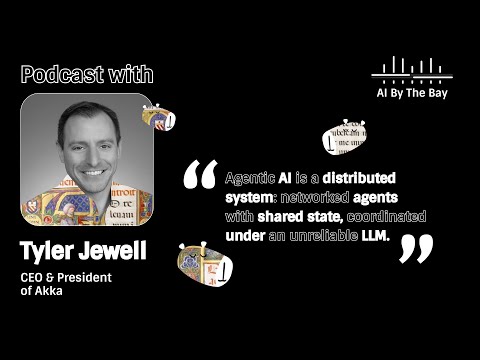
Akka has pivoted into a platform for running stateful agentic systems at enterprise scale and claims 45 customers in production plus a recent competitive win over LangChain. It runs on the JVM with an SDK that wraps actors, persistence and orchestration so teams move from prototypes to 24/7 services; Akka cites one Akka core equals 5–7 Python cores and $2–4k/year compute savings. Concrete deployments include Swiggy: sub‑millisecond model inference and Tubi real‑time personalization using half a dozen models.
AI-written summary · about
chapters (11)
- 0:00Introduction and welcome
- 0:44Speaker's background and AKA's evolution
- 3:30AKA's pivot to Agentic AI
- 7:45Reliable AI and AKA's advantages
- 8:47Production customers and use cases
- 11:57AKA's platform value proposition
- 16:30Investment rationale and market fit
- 18:56Fintech adoption and JVM benefits
- 22:49Intellectual roots of AKA
- 25:58Future of Agentic AI and enterprise orchestration
- 28:05Closing remarks and call to action
related talks
 39mAkka.net: The actor programming model
 37mAkka Present and Future
 01h 14mAkka.NET: The Future of Distributed Programming in .NET
 47mNetworks and Types — the Future of Akka
 44mDeath to Latency: Building Reactive, Cloud Native Apps with Akka NET
 25mSPARK AND AKKA FOR BIG DATA SYSTEMS, IN PRACTICE
 01h 59mAkkaCluster and AkkaTyped DeepDive Into the ActorModelWith a BitofEyeCandy.
 41mHands on Introduction to Distributed Systems Concepts with Akka Clustering