Microkernel Goes General: Performance and Compatibility in the HongMeng Production...

Talkat 18th USENIX Symposium on Operating Systems Design and Implementation (OSDI '24) · 2024-07-10..07-12·
summary
HongMeng (HM) is a Linux-ABI-compatible commercial microkernel with a 90k-line core and ~1M lines of user services, deployed on tens of millions of devices and certified for high-level industry standards. It cuts IPC overhead by classifying services into differentiated isolation classes (class‑0..2), removes double bookkeeping with policy‑free kernel paging, and replaces some capabilities with address‑token‑based access control. Driver containers run a lightweight Linux runtime for compatibility. Measured wins include ~17% faster end‑to‑end app latency, 10% fewer frame drops, and ~19% lower instruction load.
AI-written summary · about
chapters (11)
- 0:00HongMeng microkernel intro
- 3:11Microkernel design principles
- 4:36IPC and isolation challenges
- 6:23HongMeng isolation classes
- 7:45Reducing IPC overhead
- 8:27Capability access control
- 9:54Linux ABI compatibility
- 11:16Driver containers reuse
- 12:38Implementation and deployment
- 13:20Performance benchmarks
- 14:02Commercial deployment lessons
related talks
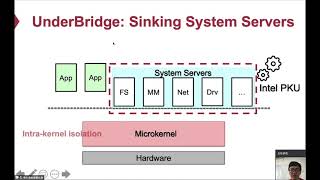 21mHarmonizing Performance and Isolation in Microkernels with Efficient Intra-kernel
 01h 03mMINIX 3
 15mμEFI: A Microkernel-Style UEFI with Isolation and Transparency
 22mLXDs: Towards Isolation of Kernel Subsystems
 52mThe Linux Kernel Hidden Inside Windows 10
 50mMPK/PKS Linux Kernel Compartmentalization
 35mThe Xenomai Project : Current and Future
 48mKernel TEE Subsystem Evolution