Break the silo: How we built a decentralized control plane for service orchestration

summary
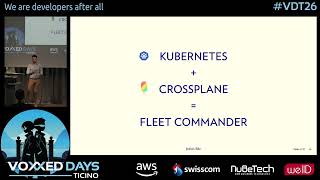
Julius Baer builds a decentralized control plane called Fleet Commander using Kubernetes + Crossplane (deployed on AKS), Flux for GitOps, provider-kubernetes as the integration layer, Vault for secrets and OPA for policy. Infrastructure teams own Crossplane providers and write Crossplane compositions in a Go-based SDK; the commander enforces a standardized public API while units reconcile native resources. Demo shows Git repo → commander → unit creating real S3 buckets and a no-op “number” resource, and the system works in production for hundreds of apps and ~800 engineers.
AI-written summary · about
chapters (9)
- 0:00Introduction
- 1:19Why we built decentralized control plane
- 6:13Platform orchestrator concept
- 10:46Fleet Commander architecture
- 13:12Kubernetes and Crossplane choice
- 19:51Fleet Commander in practice
- 22:38Live demo
- 29:04Key challenges
- 34:28Q&A
related talks
 36mBreak the silo: How we built a decentralized control plane for service orchestration
 37mPlatformOps with Crossplane
 27mGitOps Based Infrastructure as Code with Rancher Fleet and Crossplane
 27mKubernetes as a Universal Infrastructure Control Plane
 33mEliminating the Gap Between Development and Production with Kuber...
 05mWhat Can Crossplane Actually Do? A Real World Fiel...
 31mLearnings From Providing A Platform API With Kubernetes And Crossplane
 48mDoing multi-provider Kubernetes in GitOps mode with CrossPlane