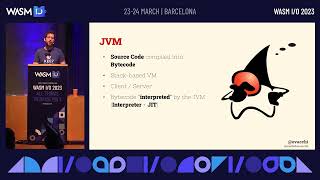
Wasmer Things: An Upside-Down Guide to WebAssembly

summary
Explains why WebAssembly becomes a portable compilation target and runtime for server and browser code, shows tooling: WASI for safe sandboxed syscalls, runtimes like Wasmer and Wasmtime, and packaging via wapm; demos include turning a hello.wasm into a web app with Wagi/Spin and running a recompiled Zork text game successfully, plus embedding Rust/C++ modules inside Go via wazero. Argues portability (single binary per architecture), structured control flow for fast JIT, and active ecosystem adoption (Docker experimental wasm support).
AI-written summary · about
chapters (58)
- 0:00Introduction
- 0:27Downloading WebAssembly
- 1:23Edoardo Vacchi
- 1:53Tetrate
- 2:14Wasmer Things
- 2:57History of WebAssembly
- 3:25Old Browsers
- 4:08JavaScript
- 4:39Plugins
- 5:59Problems with plugins
- 8:14Plugins were deprecated
- 8:29JavaScript is not a serious language
- 8:58JavaScript as a compilation target
- 10:51GUIT GW to Google Web Toolkit
- 11:19J2CL
- 11:33Native Client
- 14:10ASMJ
- 15:50Epic Citadel
- 16:50What is WebAssembly
- 17:44JVM vs WebAssembly
- 18:14WebAssembly vs CLR
- 18:26WebAssembly vs Docker
- 18:52What are Linux containers
- 19:22Nested VM
- 20:17Invoke Dynamic
- 21:07What is LLVM
- 23:15LLVM IR
- 24:34LLVM Disadvantages
- 25:13JS Runtimes
- 25:55Portable Compilation Target
- 26:51languages that support WebAssembly
- 27:10structure stack machine
- 27:48jvmcl
- 28:20structural control flow
- 29:41bytecode
- 29:56wasmertext
- 34:21nodejs
- 35:06vizing
- 35:38safety
- 37:17Runtimes
- 37:44Wasmer
- 38:05Wasmertime
- 38:21Envoy
- 38:38RedPanda
- 38:48Zig
- 39:12Crosslet
- 39:25Spin
- 41:05Hello World
- 41:34Spin up
- 42:03Applause
- 42:45Wago
- 43:02Go
- 43:24Zork
- 43:45Mailbox
- 43:58Questions
- 45:53Java on WebAssembly
- 46:31Codeling
- 46:41Garbage Collection