Supercharge your JVM performance with Project Leyden
summary
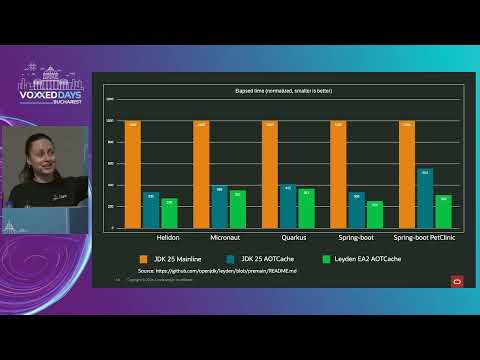
Project Leyden delivers an ahead‑of‑time AOT cache workflow (record → assemble → run or combined two‑phase) that ships in JDK 24–26 and cuts startup by about 62% in JDK 24 and up to 66% in JDK 25 on hello‑worlds; Leyden EA adds ~9% more. It requires same JDK/OS/arch, classpath as a list of jars (no nested jars), and works with extracted Spring Boot jars; demo on Spring Pet Clinic boots ~1s and combining Spring AOT drops time‑to‑first‑request from 958ms to ~750ms.
AI-written summary · about
chapters (25)
- 0:00Introduction
- 1:59JDK in production
- 2:41Java performance and Leyden
- 3:24Project Leyden goals
- 5:08Shifting workloads
- 6:11Training runs in JDK 24
- 7:36Benchmarking JDK 24
- 8:59JDK 25 improvements
- 10:45Two-phase AOT workflow
- 12:50AOT cache requirements
- 15:19Spring Boot class loaders
- 16:45Training run strategies
- 19:54Spring Boot setup
- 21:00Live demo: AOT cache
- 24:07Performance results
- 25:29AOT vs Spring AOT
- 27:13Operational approaches
- 29:22Containerized AOT cache
- 31:49Cache validity and portability
- 33:33Security and complexity
- 34:14Quarkus and Leyden
- 35:38JDK 26 improvements
- 37:44GC alignment in JDK 26
- 38:49Future outlook
- 39:11Q&A
related talks
 51mSupercharge your JVM performance with Project Leyden
 45mSupercharge your JVM performance with Project Leyden and Spring Boot
 42mSupercharge your JVM performance with Project Leyden and Spring Boot
 43mStep up the performance game with Spring Boot and Project Leyden
 45mProject Leyden: Improving Java’s Startup Time
 46mProject Leyden's AOT - Shifting Java Startup into High Gear
 46mAssembling Project Leyden
 23mAhead of Time Computation